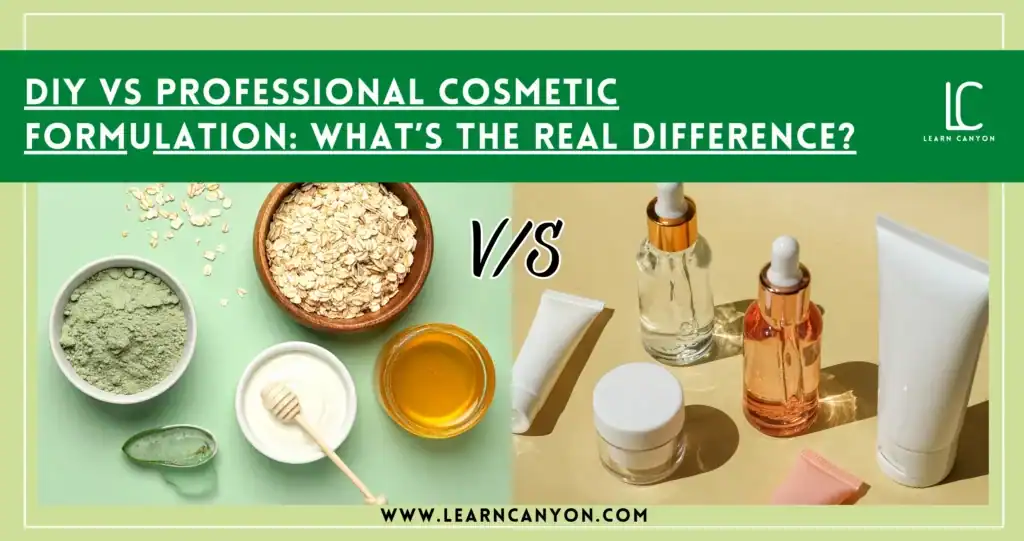
Introduction: Why This Conversation Matters
DIY skincare videos make Cosmetic formulation look simple and satisfying. You mix a few ingredients, pour them into a jar, and suddenly you have something that feels like a finished product. That excitement is real, and honestly, most formulators begin exactly there.
But experience teaches something important over time. If DIY formulations truly worked long-term, we wouldn’t see products separating after a few weeks, growing mold, or causing irritation despite being “all natural.” These issues are not rare they are common.
The truth is that DIY skincare and professional cosmetic formulation are fundamentally different, and confusing the two is where most beginners struggle. Understanding this difference can save you time, money, and a lot of frustration.
What DIY Skincare Really Is
DIY skincare is created with a home-use mindset. It is meant for personal experimentation, learning, and short-term use. There is nothing wrong with this stage it plays an important role in understanding ingredients and textures.
DIY typically involves:
- Small batch preparation
- Personal or family use
- Short shelf life expectations
- Minimal environmental exposure
However, DIY products are not designed to survive real-world conditions. They are not meant to sit on shelves for months, travel through heat and humidity, or be used by many different skin types.
DIY works in controlled environments. Professional products must work everywhere.
What Makes a Cosmetic Formulation “Professional”
A professional formula is not defined by expensive ingredients. It is defined by intentional design and logical thinking. Every component of the formula serves a purpose.
Professional formulation is built on three core pillars.
Structure
A professional formula is created in clearly defined phases, not mixed randomly. Ingredients are selected because they solve a specific formulation problem, not because they are trending.
- Water phase, oil phase, and cool-down phase are planned
- Ingredient compatibility is checked
- Each component has a function
Stability
A professional product must remain consistent from the first use to the last.
- Texture should not change
- Separation should not occur
- Color and smell must remain stable
- Performance should stay predictable
Safety
Natural does not automatically mean safe. Professional formulation respects skin biology.
- pH is controlled
- Ingredient interactions are considered
- Skin barrier health is prioritized
Percentages, Phases & Preservation
Why Professionals Never Eyeball Ingredients
One of the biggest differences between DIY and professional formulation is precision. DIY often relies on spoons, drops, and visual estimation. Professional formulation does not.
Professionals work with:
- Exact percentages
- Defined functional ranges
- Clear phase separation
- Calculated preservative systems
This is essential because a formula must work at every scale from 100 grams to manufacturing batches. A formula that only works when eyeballed cannot be scaled or reproduced reliably.
Consistency is not optional in professional formulation.
Safety & Shelf Life Differences
Why Natural Products Still Spoil
Many beginners believe natural products do not need preservation. In reality, natural ingredients can spoil even faster than synthetic ones.
Natural formulations spoil because:
- Aloe vera and hydrosols feed microbes
- Herbal extracts carry microbial load
- Water creates an ideal growth environment
Professional formulation accounts for these risks by designing for safety from the start.
- Broad-spectrum preservatives are used
- pH is adjusted correctly
- Packaging exposure is considered
- Repeated user contact is planned for
DIY often overlooks these real-world factors, which is why spoilage occurs.
Spoilage is not failure, it is biology
Can DIY Products Be Sold?
From both a legal and ethical perspective, DIY products are not meant for sale. Selling cosmetics comes with responsibility toward the end user.
Selling requires:
- Stability testing
- Microbial safety validation
- Ingredient and regulatory compliance
- Proper labeling and documentation
Many small brands fail early not because they lacked marketing, but because their product foundation was DIY-level. When customers experience separation, odor changes, or irritation, trust breaks and trust is very hard to rebuild in skincare.
When Should You Move From DIY to Professional Formulation?
There comes a clear point where DIY is no longer enough. That moment is different for everyone, but the signs are usually obvious.
You are ready to move forward if:
- You want to sell your products
- You want consistent results every batch
- You need shelf life beyond a few months
- You want confidence in safety and stability
- You want to scale without fear
This shift is not about becoming “serious.”
It is about becoming responsible
How Professionals Think Differently
DIY thinking focuses on mixing ingredients together. Professional thinking focuses on solving problems before they happen.
Professionals ask:
- What skin concern am I addressing?
- How should this product feel and behave?
- What can go wrong over time?
- How do I prevent instability, irritation, or failure?
Professional formulation is not recipe-following. It is intentional problem-solving backed by logic and testing.
DIY skincare is a beautiful starting point. It sparks curiosity and creativity. But it is not the final destination for anyone who wants to create safe, stable, and scalable products.
Professional formulation offers:
- Control
- Consistency
- Confidence
- Credibility
If you feel like you have outgrown DIY but don’t yet know your next step, you are not lost.
You are evolving and that is exactly how every real formulator begins.