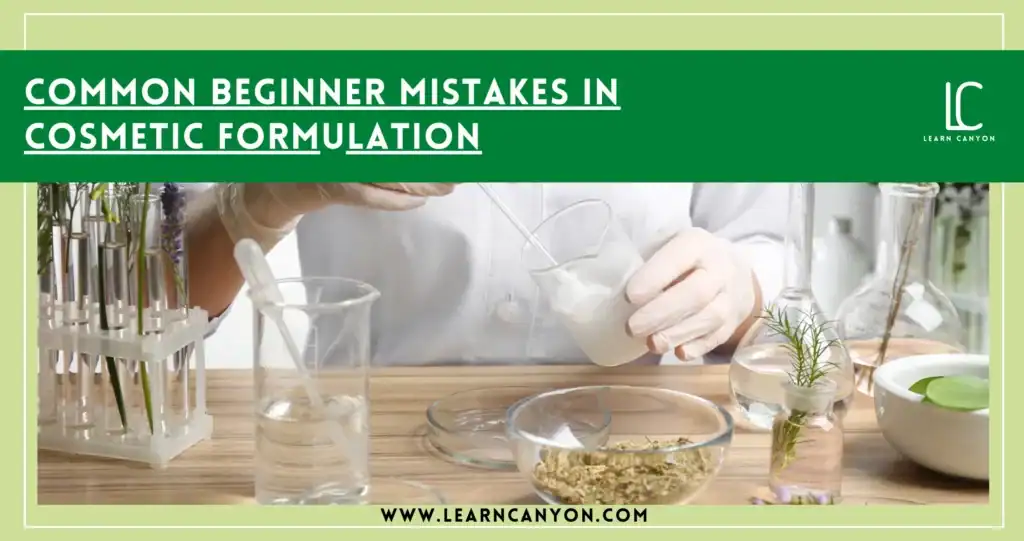
Introduction: Let’s Be Honest for a Minute
Every formulator fails. That’s not a weakness it’s part of the process. The real difference is not who failed and who didn’t, but who learned from those failures correctly and who kept repeating the same mistakes hoping for a different result.
When you’re starting out, it’s easy to feel discouraged when a product separates, smells off, or doesn’t behave the way you imagined. I’ve been there more times than I can count. The good news? Most beginner mistakes are predictable, and once you understand them, you can avoid wasting months of trial and error. Let’s shortcut that learning curve together.
Why Beginner Formulas Fail
Most beginner formulas don’t fail because of lack of passion or effort. They fail because formulation is approached emotionally instead of structurally.
Common reasons formulas fail:
- Jumping straight into ingredients without understanding their role
- Guessing percentages instead of working with ranges
- Ignoring ingredient compatibility and formulation logic
- Treating formulation like cooking instead of applied science
Cosmetic formulation is more like building a house. If the foundation is weak, the most beautiful design won’t stand for long.
Overusing Essential Oils
This is one of the most common beginner traps. Many new formulators believe that because essential oils are natural, they can be used freely. I believed this too in my early days until I understood how potent they really are.
Where beginners go wrong:
- Using 2–3% essential oils in face or scalp products
- Mixing too many essential oils “for benefits”
- Not checking dermal limits or IFRA guidelines
Essential oils are actives, not just fragrance ingredients. Using more doesn’t make a product better, it often makes it irritating. A well-formulated product works quietly and effectively, not aggressively.
Ignoring Preservation
Preservation is often ignored until mold, odor, or separation shows up.
Beginners commonly think refrigeration, essential oils, or herbal extracts are enough. Unfortunately, microbes don’t care about good intentions.
Preservation is essential when your formula contains:
- Water or hydrosols
- Aloe vera or floral waters
- Botanical extracts or infusions
Preservation isn’t about fear; it’s about responsibility. A product that looks fine can still be unsafe. Whether it’s for personal use or for selling, safety is non-negotiable.
The Copy–Paste Formula Trap
The internet is full of formulas and that’s both a blessing and a problem. Many beginners rely heavily on copied recipes without understanding what’s happening behind the scenes.
The risks of copy-paste formulation:
- No understanding of why ingredients are used
- Inability to troubleshoot when something goes wrong
- Formula failure when even one ingredient is substituted
Professional formulation isn’t about memorising formulas. It’s about understanding frameworks. Once you understand why a formula works, you stop depending on random recipes.
Texture Obsession vs Stability
We all love luxurious textures silky creams, glossy gels, fluffy butters. Texture matters, but not more than stability.
I’ve seen products that felt incredible on Day 1 but failed after a week.
Common beginner focus mistakes:
- Prioritising feel over structure
- Ignoring temperature and storage stability
- Not observing the product over time
A professional formula must survive heat, cold, and time. Stability always comes before aesthetics because an unstable product is never truly finished.
Skipping pH Testing
This is a silent mistake that causes long-term issues.
Skin can’t “feel” pH, and fingers can’t measure it. Without testing, even a well-designed formula can fail.
Problems caused by incorrect pH:
- Actives not working as intended
- Preservatives becoming ineffective
- Gradual skin irritation
pH testing is not optional it’s basic formulation hygiene. Strips or meters are essential tools, not advanced extras.
Not Documenting Formulations
Almost every beginner says, “I’ll remember what I did.” No one does and that’s okay.
Without documentation, you can’t:
- Recreate a successful batch
- Understand why a batch failed
- Improve or scale a formula
A formulator’s notebook is powerful. Write down percentages, temperatures, method, and observations over time. This single habit can completely change your formulation journey
Turning Failures Into Learning
This is where real growth happens.
A failed formula isn’t wasted effort it’s feedback. Every separation, graininess, or instability is teaching you something about ingredients and systems.
What failures teach you:
- Balance in emulsions
- Crystallisation behavior in butters
- Polymer and gum performance
- Ingredient compatibility
The only true mistake is failing and not asking why. Once you start treating failures as lessons, formulation becomes exciting instead of frustrating.
If you’re making mistakes, you’re doing something right you’re actually formulating. What matters is learning with structure, safety, and clarity.
Cosmetic formulation isn’t about perfection. It’s about understanding, responsibility, and steady progress. And when things finally click, there’s nothing more empowering than creating products that are not just beautiful but truly professional.
You’re on the right path. Keep going.