



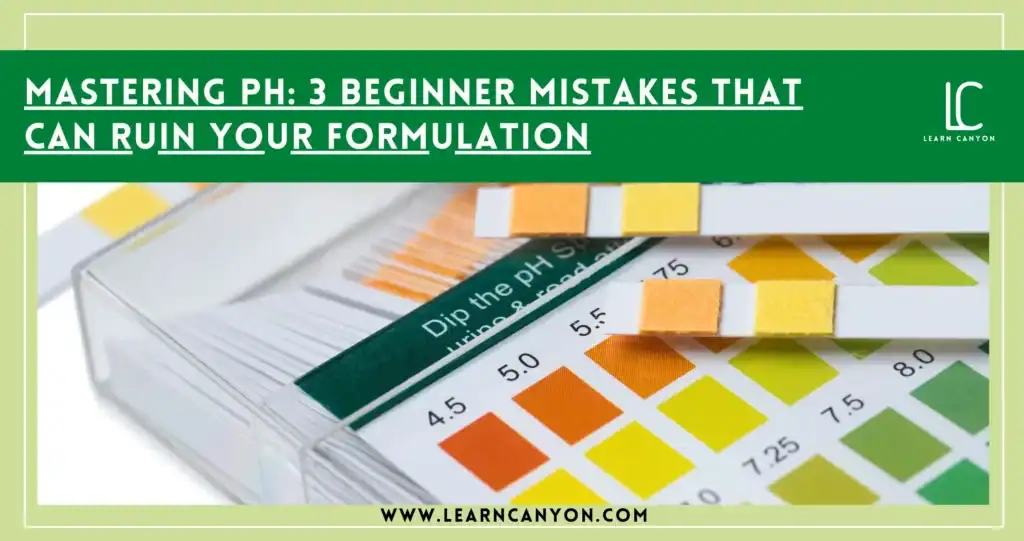
Let’s get one thing straight, pH isn’t just a number. It’s the heartbeat of your formulation.
As a formulator, especially if you’re just starting out, it’s easy to get swept away by beautiful oils, exotic extracts, and dreamy actives. But if your pH is off, even the most luxurious ingredients can turn into a skin disaster. Redness, irritation, poor shelf life, unstable emulsions, yes, all that can stem from pH imbalance.
The skin has its own delicate ecosystem, a slightly acidic barrier called the acid mantle. Your job as a formulator is to respect that. When you balance pH correctly, your formulation doesn’t just work better, it feels better, lasts longer, and supports skin health in the long run.
In this blog, we’re diving into the three most common pH mistakes new formulators make and how to avoid them. Whether you’re making toners, serums, or emulsions, this is your reminder that pH isn’t optional, it’s essential.
Mistake #1: Ignoring the pH of Raw Materials
This one’s a sneaky trap, and trust me, I’ve seen even advanced formulators fall into it.
You’ve carefully planned your formula. You’ve chosen the right emulsifier, checked your preservative’s efficacy range, and you’re ready to go. But wait… did you test the pH of your hydrosols? What about your botanical extracts? Or that new batch of aloe vera juice?
Every raw material brings its own natural pH, and it can vary from supplier to supplier or even batch to batch. A lavender hydrosol from one source might sit at pH 4.5, while another could be closer to 6. If you’re formulating blindly, assuming everything will balance out at the end, you’re setting yourself up for disappointment.
Here’s the deal: you must test and record the pH of every water-soluble ingredient before even starting your formula. This gives you a much clearer idea of what your final pH will look like and helps you adjust smartly, not randomly.
It’s like baking a cake and not checking if your flour is self-raising or plain. Your result might still look okay… until it flops!
So, don’t ignore your raw materials. Your formulation’s stability, effectiveness, and skin-friendliness depend on it.
Mistake #2: Adjusting pH Too Soon (or Too Late)
Timing, my friend, is everything, especially when it comes to pH.
One of the most common hiccups I see with new formulators is jumping in too quickly to adjust pH… or waiting until it’s way too late. Both can mess with your formulation’s integrity and stability.
Let’s say you’re making a cream. You check the pH right after blending your water phase. It’s too high, so you go ahead and drop in a little citric acid. But then you add your actives, preservatives, and emulsifier, and surprise! The pH drops further than expected, and now it’s way too low. Oops. You end up chasing the pH up and down like a ping-pong match.
Here’s what I always teach my students:
Don’t adjust the pH until your formula is completely blended, emulsified (if applicable), and cooled down to room temperature.
Why? Because certain ingredients, like gums, actives, and emulsifiers, can dramatically shift the pH as they interact or hydrate. Temperature also affects how pH is measured. If you’re testing while the formulation is still warm, you’re not getting the real picture.
The sweet spot? Once your formulation is at room temp and all ingredients are in, then you measure, and then you adjust. You’ll get much more accurate readings and far fewer surprises.
Think of it like frosting a cake: you wouldn’t ice it straight out of the oven, right? Same goes for pH. Let it settle before you fine-tune.
Mistake #3: Using the Wrong pH Adjusters
Okay, let’s clear up a common confusion, not all pH adjusters are created equal. And no, just because something is “acidic” or “alkaline” doesn’t mean it’s right for your formula.
I often see new formulators reach for citric acid or baking soda without considering the bigger picture. While these are commonly used, they’re not always the best fit, and in some cases, they can completely destabilize your product.
For example, citric acid is great in water-based systems like toners or gels, but it can clash with emulsions if not diluted and added properly. Sodium bicarbonate might raise the pH, yes, but it can also introduce fizzing, change texture, or interact poorly with certain actives or thickeners.
And don’t even get me started on using things like vinegar or lemon juice, those belong in the kitchen, not your formulation lab!
Here’s the pro tip: Always choose a cosmetic-grade pH adjuster that aligns with your product type, preservative system, and skin compatibility.
Some of my go-tos? Lactic acid, sodium hydroxide solution, citric acid solution, and arginine, depending on the formula, of course.
Also, always work in diluted solutions. Adding dry acid powders directly to your product? That’s a one-way ticket to uneven pH and gritty textures.
pH adjusting is not just about shifting numbers, it’s about doing it gracefully, gently, and with full understanding of the chemistry behind your product.
Formulator’s Insight:
Let’s have a real formulator-to-formulator moment here, because if there’s one lesson I wish every beginner could internalize early on, it’s this: pH isn’t just about skin feel. It’s directly tied to your product’s stability, safety, and shelf life.
I can’t tell you how many times I’ve had students come to me saying, “But my emulsion was perfect at first… then it separated after a week.” And my first question is always: “Did you test and record the final pH?”
You see, the pH level affects:
- Preservative performance – Some preservatives only work within a narrow pH range. If you’re outside that range, they may be useless.
- Emulsion stability – Certain emulsifiers have preferred pH zones. If you’re too far off, even a beautiful emulsion can slowly break apart.
- Active ingredient efficacy – Vitamin C, AHAs, niacinamide… all of them have specific pH ranges where they actually work best without degrading or causing irritation.
- Microbial growth – Too high or too low, and you’re either creating a party for bacteria or degrading your formula entirely.
That’s why when I create a formula, I don’t just jot down the pH, I build a pH strategy. I think about how it may shift over time, how the preservative will hold up, and what environment the actives need to thrive.
Think of pH as the invisible structure holding your formula together. When it’s balanced, your formulation can stand tall for months, even years. But when it’s unstable? Everything starts to crumble, even if it looks fine on the surface.
So yes, pH and stability go hand-in-hand. Always.
Sample Case Study:
Alright, let me take you behind the scenes of one of my early formulation “oops” moments, the kind that humbles you, teaches you, and eventually becomes your favorite story to share with students.
I was working on a beautifully hydrating facial toner, it had rose hydrosol, cucumber extract, panthenol, and a touch of aloe vera juice. The formula looked clean, felt refreshing, and smelled divine. I was thrilled.
The next morning, I checked on it… and there it was, a slight cloudiness. By Day 3, it had developed a weird scent, and I knew something wasn’t right.
So what went wrong?
I had skipped measuring the individual pH of my water-soluble ingredients. I assumed everything was “neutral enough” and adjusted pH only at the end. Turns out, the cucumber extract had a naturally high pH, and the aloe juice was leaning acidic, but together, they pulled my final product’s pH just above 6.5. And guess what? The preservative I used, Geogard, is only effective below pH 6.
That one tiny oversight cost me the entire batch.
But here’s what I gained:
I never again skipped pH testing at every stage. Now, I always record the pH of individual raw materials, adjust slowly, and give myself buffer room around the preservative’s ideal range.
Sometimes, the best lessons are the ones that sting just a little.
So if you’re in that stage where you feel like you’re doing everything right but something still goes off, double-check your pH. It might just be the missing puzzle piece.

Pro Tips to Master pH Like a Skincare Scientist
If there’s one thing I’ve learned over the years, it’s that mastering pH doesn’t mean memorizing numbers, it’s about building habits. Smart, intentional habits that make every formulation more stable, more effective, and more skin-loving.
Here are my go-to pH tips, the ones I use in every single formula:
Always work with diluted pH adjusters.
Never toss citric acid or sodium bicarbonate straight into your product. Create a 10% solution (or appropriate dilution) and add it drop by drop. This gives you precision, not panic.
Test pH at room temperature, not while it’s hot.
Warm formulations can give false readings. Always let your product cool down before you reach for that pH meter. Trust me, this one little habit can save you so much confusion.
Use a proper pH meter, not just strips.
pH strips might look cute and convenient, but they’re not accurate enough, especially when you’re formulating professionally. Invest in a good-quality pH meter, calibrate it regularly, and treat it like your lab partner.
Know your preservative’s sweet spot.
Every preservative has a pH range where it performs best. Make that range non-negotiable in your formulation, because even the most elegant product is useless if it can’t stay safe and preserved.
Track pH over time.
Don’t just test it once and move on. Recheck pH after 24 hours, a week, and again during stability testing. Some formulas shift subtly, and catching that early can help you reformulate smarter.
Log everything.
Keep a formulation journal or digital tracker where you record the pH of each raw material, your final product, and any adjustments made. Patterns will start to emerge, and that’s when real mastery begins.
pH might seem technical at first, but once you treat it like a part of your formulation rhythm, it becomes second nature. Just like a chef knows when to season, a great formulator knows when, and how, to pH balance like a pro.
Conclusion
pH might just be a tiny number on your formulation sheet, but don’t be fooled, it carries big responsibility.
From how your product feels on the skin to how long it stays fresh on the shelf, pH is working behind the scenes to hold everything together. And when you understand it, respect it, and work with it, not against it, your formulas evolve from “okay” to truly professional.
As a formulator, learning to master pH is like learning to listen to your formulation. It tells you when things are balanced, when they need adjusting, and when they’re truly ready for the world. So don’t treat it like an afterthought, treat it like your silent stability partner.
Whether you’re making a soothing aloe toner, a complex anti-aging serum, or a luxurious emulsion, pH matters. And now, you know how to make it work in your favor.
Keep formulating mindfully, trust your tools, and always double-check that little number… because in the end, that’s where the magic lives.






1 thought on “Master pH: 3 Mistakes That Ruin Skincare Products”
Superb guidance about PH ,such informative details help the beginners a lot ,Thank you Sir!