If you’ve been formulating for a while, you’ve probably nailed a few oil-in-water lotions with that beautiful, lightweight moisturiser that absorbs in seconds and leaves no residue. It’s a great starting point. But at some stage in your formulation journey, you’ll want to explore the other side of the emulsion world.
Water-in-oil emulsions. Richer. More protective. More complex. And honestly? More satisfying to get right.
This guide will walk you through exactly what water-in-oil (W/O) emulsions are, how they differ from the lotions you already know, how to build them properly, and the real mistakes that cause them to fail – including some that don’t get talked about enough. Whether you’re formulating barrier creams, winter skin balms, baby creams, or water-resistant sunscreens, this is the foundation you need.
What Is a Water-in-Oil Emulsion?
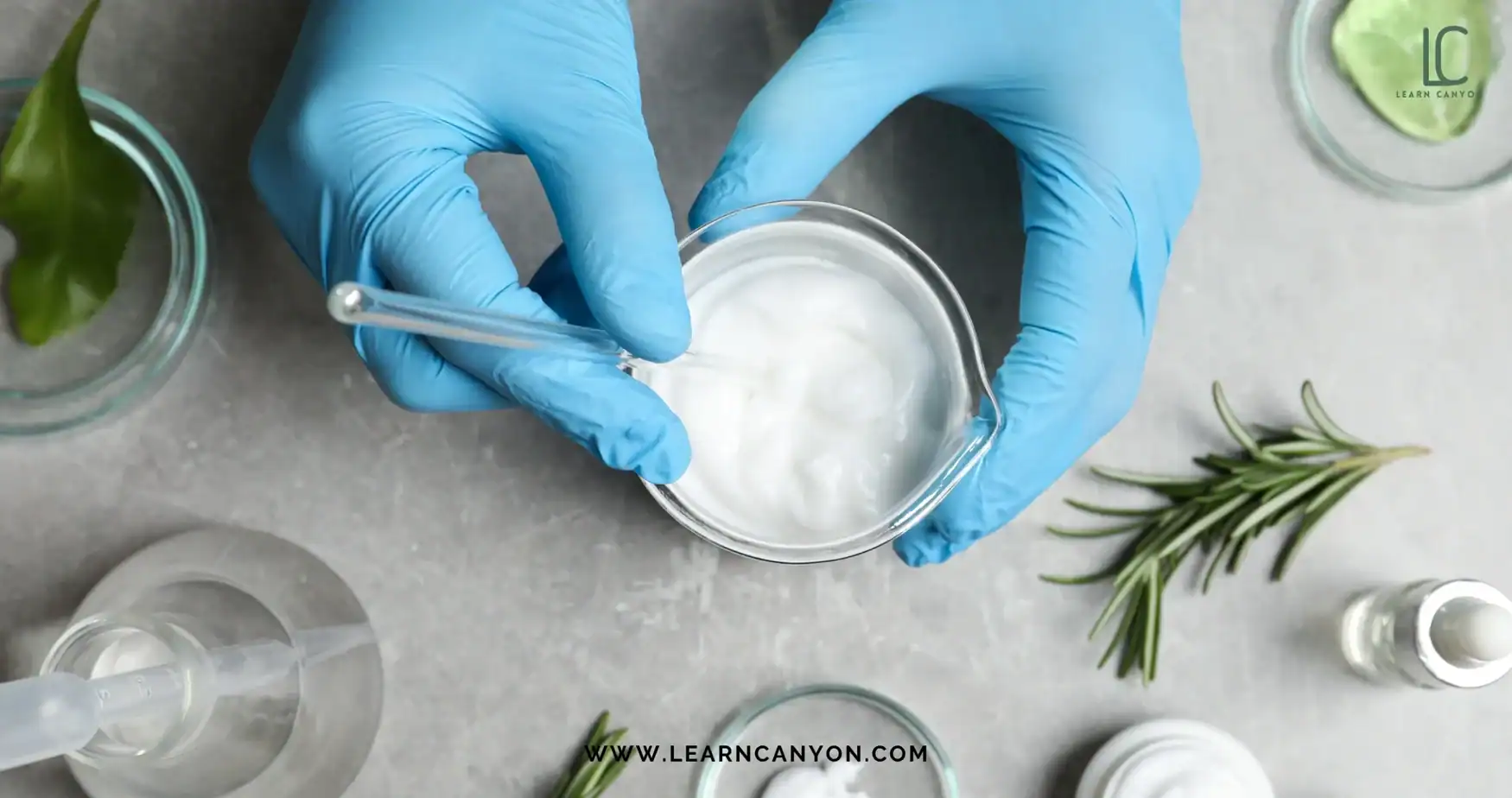
At its most fundamental level, an emulsion is a mixture of two liquids that don’t naturally want to mix – oil and water – held together by an emulsifier.
In an oil-in-water emulsion (O/W), tiny droplets of oil are dispersed throughout a continuous water phase. The outer phase that touches your skin first is water. That’s why most everyday lotions feel light and fresh – they’re essentially water-dominant systems.
In a water-in-oil emulsion (W/O), it’s the opposite. Tiny droplets of water are dispersed inside a continuous oil phase. The outer phase is oil. This means the very first thing your skin contacts when you apply a W/O cream is oil – and that changes everything about how the product performs.
This is not just a technical distinction. It has profound implications for skin feel, moisture retention, protection, sensory experience, and who the product is for.
Products Typically Formulated as W/O Emulsions
- Rich barrier repair creams
- Cold creams and cleansing creams
- Winter protective creams
- Baby barrier and nappy rash creams
- Water-resistant sunscreens
- Heavy-duty hand and foot creams
- Massage creams
- Dry and mature skin treatments
- Thick, occlusive night creams
W/O vs. O/W: Choosing the Right System for Your Product
One of the most important decisions you make when designing a new product is choosing your emulsion type. This is not a stylistic choice – it should be driven by the product’s intended performance, the skin condition it’s targeting, and the experience you want the consumer to have.
- Water is the continuous (outer) phase
- Feel: light, refreshing, quick-absorbing, non-greasy
- Easy to apply and rinse off
- Well-suited for daily moisturisers, day creams, body lotions, gel-creams
- Generally easier to formulate and stabilise
- Preservation is critical because water is the dominant phase
- Oil is the continuous (outer) phase
- Feel: rich, creamy, protective, cushioning, more occlusive
- Resistant to water – not easily washed away
- Well-suited for barrier creams, baby products, winter skincare, protective sunscreens
- More technically demanding to formulate and stabilise
- Preservation is still essential – the internal water phase supports microbial growth
Neither system is better than the other. They simply serve different purposes. A professional formulator chooses based on intended function – not habit or convenience.
Why Formulate Water-in-Oil Emulsions?
Let’s talk about the genuine reasons to choose a W/O system – not just because it sounds impressive, but because it delivers real benefits that an O/W formulation simply cannot replicate.
Benefit 1Superior Skin Barrier Support
Because oil is the continuous phase in a W/O emulsion, when the product is applied to skin, it deposits an oil-rich film across the surface. This film significantly reduces transepidermal water loss (TEWL) – the passive evaporation of water through the skin’s outer layers.
For dry, cracked, compromised, or mature skin, this occlusive action is therapeutically valuable. It gives the skin time and conditions to repair itself.
Benefit 2Hydration and Nourishment in One System
This is one of the most elegant things about a well-designed W/O emulsion: you get both. The water phase delivers humectants and water-soluble actives directly to the skin, while the oil phase provides lipid replenishment and a protective cover. Done well, a W/O cream delivers richer, more sustained nourishment than most O/W formulations.
Benefit 3Water Resistance
Because the outer phase is oily, W/O emulsions are inherently more resistant to water contact. This is why mineral sunscreens, baby bum creams, and outdoor protective balms so often use W/O systems – they stay on the skin even when exposed to sweat, wet conditions, or repeated hand washing.
Benefit 4Performance in Cold or Dry Climates
Light O/W lotions are brilliant in mild climates, but in cold, windy weather or arid conditions, they can actually contribute to moisture loss if the humectants they contain draw from the skin rather than the environment. A W/O cream provides a physical barrier against environmental moisture loss – exactly what winter skin needs.
Benefit 5Long-Wearing Comfort on Very Dry Skin
Severely dry areas – heels, elbows, knuckles, cuticles – benefit enormously from the staying power of a W/O formula. These products sit on the skin longer and maintain their protective effect through friction and movement in a way that lighter creams simply don’t.
Why Are W/O Emulsions More Challenging to Make?
There’s a reason W/O emulsions are covered at a more advanced stage in professional formulation training. They require a more exacting approach across multiple variables.
The core challenge is this: in an O/W system, you have a forgiving, water-dominant outer phase. Water blends easily with most ingredients and tolerates a range of formulation decisions. In a W/O system, you’re trying to hold tiny water droplets suspended inside oil – and oil is unforgiving if your emulsifier choice, phase ratios, or manufacturing technique are off.
Common areas where things go wrong:
- Emulsifier selection – using an O/W emulsifier instead of a true W/O emulsifier
- Phase ratio – exceeding the internal water phase capacity the emulsifier system can hold
- Mixing method – adding phases in the wrong order or using incorrect mixing speed
- Oil phase structure – insufficient wax, butter, or structuring agent to support stability
- Electrolyte sensitivity – some W/O emulsifiers are highly sensitive to salts and minerals in the water phase
- Temperature management – cooling too fast or unevenly
- Inadequate stability testing – judging the formula too early
A W/O emulsion that looks beautiful on Day 1 can separate by Day 14. Always test. Stability is non-negotiable.
The Role of the Emulsifier – And Why HLB Is Only Part of the Story
The emulsifier is the single most critical ingredient in any W/O emulsion. It determines whether your emulsion forms at all, how stable it is, how it feels on skin, and what other ingredients it can accommodate.
You may have heard of HLB – Hydrophilic-Lipophilic Balance – a scale that indicates whether an emulsifier prefers oil or water. W/O emulsifiers typically have a low HLB value (roughly 3-6), indicating a stronger affinity for oil, which makes sense given that oil is the continuous phase.
However, HLB is a guide, not a guarantee. In professional practice, the behaviour of an emulsifier in a specific formula is more important than its HLB number alone. Always follow supplier documentation and conduct your own stability testing.
Common W/O Emulsifiers (Including Natural and COSMOS-Compatible Options)
- Polyglyceryl-3 Polyricinoleate (PGPR) – highly effective W/O emulsifier; commonly used in conventional and some natural formulations
- Polyglyceryl-2 Dipolyhydroxystearate – popular in natural and certified organic formulations; works well with structured oil phases
- Sorbitan Olivate – olive-derived; often used in combination for O/W systems, but can contribute to some W/O-leaning systems depending on the blend
- Sorbitan Oleate – W/O-leaning; commonly used in combination with other emulsifiers
- Glyceryl Isostearate – good W/O building block, often used as part of an emulsifier blend
- Lecithin-based systems – phospholipid emulsifiers that can create W/O or lamellar structures depending on concentration and formulation
- Silicone-based W/O emulsifiers – used in conventional cosmetics and sunscreens; not suitable for natural or organic certifications
Do not assume any natural emulsifier will create a stable W/O emulsion. Many natural emulsifiers – including popular ones like Olivem 1000 – are designed for O/W systems. Using them in a W/O formula will typically result in phase separation. Always verify emulsifier type from supplier technical data sheets before formulating.
The Architecture of a Water-in-Oil Emulsion
A well-designed W/O emulsion is built from three distinct phases. Understanding what goes in each phase – and why – is fundamental to professional formulation.
Phase AThe Oil Phase – The Continuous / Outer Phase
This is where the structural character of the product lives. The oil phase determines richness, skin feel, occlusion, spreadability, and stability. It must be well-structured and cohesive before the water phase is introduced.
Typical oil phase components:
- Carrier oils – provide emolliency and nourishment (e.g., jojoba, rosehip, marula, hemp seed, sea buckthorn)
- Butters – add richness and structure (e.g., shea, mango, kokum, cocoa butter)
- Waxes – critical for emulsion stability; provide body and form (e.g., beeswax, carnauba, rice bran wax, candelilla)
- W/O emulsifier – must be fully melted and incorporated into the oil phase before water addition
- Fatty alcohols – optional structuring agents (e.g., cetyl, cetearyl); use with care in W/O, as some prefer O/W systems
- Oil-soluble antioxidants – protect the oils from oxidation (e.g., tocopherol / Vitamin E)
- Oil-soluble actives – e.g., fat-soluble vitamins, oil-based botanical extracts, phytosterols
Your oil phase needs structural backbone. A formula built only from light liquid oils will rarely produce a stable W/O emulsion. Include at least one wax or semi-solid butter to provide the architecture the emulsifier needs to hold water droplets in place.
The Water Phase – The Internal / Dispersed Phase
The water phase contains your humectants, water-soluble actives, and hydrating ingredients. In a W/O emulsion, this phase is the internal phase – it gets broken into tiny droplets and dispersed inside the oil. This is a key distinction from O/W formulation.
Typical water phase components:
- Distilled water or hydrosols (e.g., rose, lavender, neroli, chamomile)
- Aloe vera juice – brings humectancy and soothing properties
- Glycerin – a classic, effective humectant; generally well-tolerated by W/O systems
- Panthenol – hydrating, soothing, wound-supportive; widely used in barrier creams
- Sodium PCA – a skin-identical humectant naturally found in the NMF
- Water-soluble botanical extracts – choose carefully; some high-electrolyte extracts can disrupt stability
- Water-soluble actives – niacinamide, hyaluronic acid (low MW), and similar
- Preservative (if water-soluble) – added here for proper distribution
- pH adjuster – to manage the internal water phase pH
Some W/O emulsifiers are extremely sensitive to electrolytes – ionic ingredients in the water phase that can disrupt the emulsifier’s ability to maintain stability. High concentrations of mineral-rich extracts, salts, or some preservatives may cause phase separation. Always check your emulsifier’s technical data sheet for electrolyte tolerance, and test conservatively when introducing new water-phase ingredients.
The Cooldown Phase
Heat-sensitive ingredients that would degrade or lose efficacy if added to a hot emulsion go into the cooldown phase, added once the batch has cooled to below 40°C.
Typical cooldown phase components:
- Preservative (if heat-sensitive or not added in Phase B)
- Essential oils and natural fragrances
- Vitamin E / tocopherol (if not added to oil phase)
- CO2 extracts – highly concentrated, heat-sensitive botanical actives
- Delicate peptides or sensitive bioactives
- Final pH adjustment if needed
A Professional Starting Formula Framework
This is not a finalised, tested formula. It’s an educational framework – a starting architecture to help you understand how a W/O emulsion is built before you begin your own iterations.
- Carrier oil(s): 20-30%
- Butter(s): 5-10%
- Wax or structuring agent: 2-5%
- W/O emulsifier: 4-8% (always follow supplier recommended usage rate)
- Antioxidant (tocopherol): 0.2-0.5%
- Distilled water or hydrosol: to quantity sufficient (q.s.)
- Glycerin: 2-5%
- Panthenol: 0.5-2%
- Aloe vera juice: 5-10%
- Water-soluble extract or active: 1-3%
- Preservative: as per supplier recommendation (typically 0.5-1.5%)
- Essential oil or fragrance: 0.1-0.5%
- pH adjuster: q.s.
Total should equal 100%. Use q.s. (quantity sufficient) on your largest ingredient – typically water – to reach exactly 100% after all other ingredients are accounted for.
How to Make a Water-in-Oil Emulsion: Step-by-Step
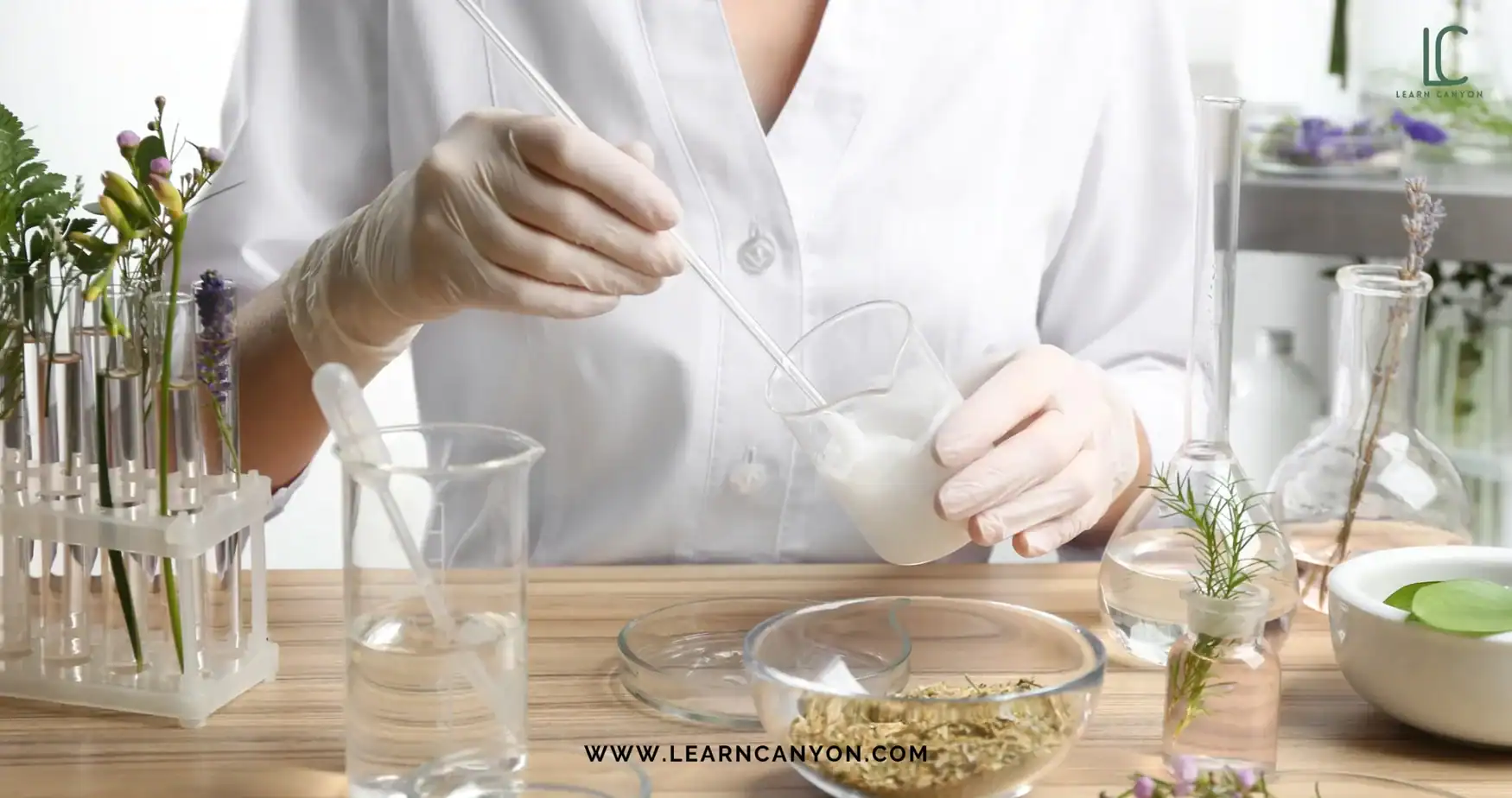
Manufacturing technique has a significant impact on W/O emulsion stability. The same formula can succeed or fail depending entirely on how it’s made. Follow this process carefully.
Step 1Prepare Phase A – The Oil Phase
Weigh all oil phase ingredients into a heat-safe beaker – oils, butters, wax, emulsifier, and antioxidant. Heat gently with occasional stirring until everything is fully melted and clear. The emulsifier must be fully dissolved into the oil phase before you introduce any water. Target temperature: 70-80°C depending on your wax and emulsifier melting points.
Step 2Prepare Phase B – The Water Phase
In a separate beaker, weigh your water phase ingredients. Dissolve all water-soluble components thoroughly. Heat to the same temperature as the oil phase – both phases must be at equivalent temperatures when combined. Temperature mismatch is a common cause of poor emulsification.
Step 3Add the Water Phase Into the Oil Phase – Slowly
This step is non-negotiable in W/O formulation. You must add the water phase into the oil phase, not the other way around. Add in a slow, thin, steady stream while maintaining continuous stirring. Adding the water phase too quickly or all at once frequently results in phase inversion or an unstable emulsion.
Step 4Maintain Steady, Controlled Mixing
Use a consistent mixing speed throughout addition. Overmixing at very high shear can destabilise some W/O emulsifier systems. Under-mixing fails to disperse the water droplets properly. A consistent medium-speed overhead stirrer or homogeniser setting works well. Some W/O emulsifiers benefit from brief periods of high-shear homogenisation – check your supplier’s processing guidelines.
Step 5Cool With Continuous Gentle Stirring
As the emulsion cools, its viscosity will increase. Continue stirring steadily throughout. Do not stop stirring mid-process and do not subject the batch to sudden cooling (e.g., placing a warm beaker in cold water). Allow natural cooling at room temperature while stirring.
Step 6Add Phase C at or Below 40°C
Once the batch has cooled sufficiently, add your heat-sensitive ingredients – preservative, fragrance, CO2 extracts, and delicate actives. Incorporate gently and thoroughly.
Step 7Check and Adjust pH
W/O emulsions present a unique challenge for pH testing – you’re measuring the pH of the internal water phase, not the emulsion surface. Measure according to a method validated for emulsions, such as diluting a small sample and testing the resulting aqueous portion. Ensure your preservative is functional within the measured pH range.
Step 8Fill Into Appropriate Packaging
W/O emulsions are best suited to jars, tubes, or airless pump dispensers. Airless packaging is preferred for commercial products – it reduces headspace, minimises contamination risk, and maintains formula integrity over time.
Common Formulation Mistakes – And What’s Actually Happening
Let’s go deeper than the standard ‘don’t do this’ lists. Here’s what’s actually happening when W/O emulsions fail.
This is the most common and most fundamental error. Olivem 1000, Emulsifying Wax NF, Cetearyl Glucoside – these are O/W emulsifiers. They will not create a stable W/O emulsion. They may briefly appear to form an emulsion, only to separate within hours or days.
Always verify your emulsifier type before you formulate. The supplier’s technical data sheet will clearly state whether the emulsifier produces O/W, W/O, or both depending on concentration.
Every emulsifier system has a maximum internal phase it can stabilise. If your water phase exceeds this capacity, the emulsifier cannot hold all the water droplets in suspension. The result: water weeping, phase separation, or an unstable, grainy emulsion.
Start conservatively. If you want a higher water phase, you’ll need either a more concentrated emulsifier system or a different emulsifier with higher water-loading capacity – and you’ll need to verify this through stability testing.
In a W/O system, always add water into oil. When you add oil into water, you’re setting up conditions for O/W emulsion formation – you may end up with a phase-inverted product, or simply an unstable mess. The order of addition is not arbitrary; it’s a fundamental manufacturing principle.
A W/O emulsion needs the oil phase to have body and structure. If your oil phase consists only of lightweight liquid oils, there’s nothing to hold the emulsion architecture in place as the product cools. Waxes, butters, and appropriate consistency agents provide the solid-state structure that keeps water droplets stable and prevents them from coalescing over time.
Some of the most effective W/O emulsifiers – particularly polyglyceryl esters – can be disrupted by electrolytes in the water phase. Sodium chloride (salt), magnesium sulfate, mineral-rich waters, certain botanical extracts, and some preservative systems all introduce ionic species that can compete with or destabilise the emulsifier interface.
Check your emulsifier’s electrolyte tolerance. If you want to include electrolyte-rich ingredients, test at low concentrations first and observe stability closely.
Many W/O emulsions look perfect on the day they’re made. The real test comes over time and under stress. Check at 24 hours, 48 hours, 72 hours, 1 week, 2 weeks, and 4 weeks minimum. Also conduct accelerated testing – heat cycling, freeze-thaw cycles, and centrifuge testing – before drawing any conclusions about stability.
Never commit to a formula for production before it has passed a proper stability protocol.
Improving the Skin Feel of W/O Emulsions
The most common criticism of W/O emulsions is that they feel heavy, greasy, or suffocating. This is not an inherent characteristic of the emulsion type – it’s a formulation problem, and it’s entirely solvable.
The goal is to select oils and emollients that deliver richness and protection without the greasy drag.
Lighter Oil Choices
Replacing or blending heavy oils (e.g., castor, avocado, olive) with faster-absorbing options significantly improves elegance:
- Squalane – lightweight, skin-identical, non-greasy, excellent oxidative stability
- Caprylic/capric triglyceride (fractionated coconut oil) – very light, fast absorbing, excellent carrier
- Coco-caprylate/caprate – elegant ester, dry after-feel
- Jojoba – technically a liquid wax; absorbs well and adds a silky quality
- Isoamyl laurate – naturally derived ester with a dry, powdery feel
- Meadowfoam seed oil – excellent oxidative stability and smooth application
Sensory Modifiers
- Tapioca starch or arrowroot powder – absorbs surface oiliness and reduces slip
- Silica or rice starch – natural dry-feel powders for a matte, velvety finish
- Carefully selected waxes – different waxes produce markedly different skin feels; rice bran wax and candelilla tend to be cleaner and less heavy than paraffin or heavy beeswax blends
Preservation – It’s Still Non-Negotiable
This is an area where beginners sometimes make a dangerous assumption: because the outer phase of a W/O emulsion is oily, they think preservation is less critical.
It is not.
The internal water phase of a W/O emulsion can absolutely support microbial growth. Bacteria, moulds, and yeasts don’t care that the water is trapped inside oil droplets – they can colonise within the aqueous environment of those droplets. A W/O emulsion without an effective preservative system is a safety risk.
When selecting your preservative:
- Confirm it is effective in emulsion systems and can partition into the water phase
- Check the recommended usage rate from your supplier
- Verify its effective pH range against your formula’s measured pH
- Consider solubility – some preservatives are oil-soluble, some water-soluble, some both
- Check compatibility with your emulsifier system
- Confirm it meets any natural or organic certification standards you’re working to
For commercial products, a full Preservative Efficacy Test (PET / Challenge Test) to ISO 11930 or equivalent standard is essential before market launch. This is not optional.
Stability Testing: What to Look For
Stability testing for W/O emulsions should be rigorous. Because these systems can be sensitive to temperature, electrolytes, and time, a thorough testing protocol is essential.
Visual and Physical Observations
- Phase separation (oil rising or water pooling)
- Water weeping or ‘sweating’ on the surface
- Graininess or crystallisation in the texture
- Changes in colour, gloss, or opacity
- Odour changes (may indicate oxidation or microbial growth)
- Viscosity changes – thickening or thinning over time
Stability Testing Conditions
- Room temperature (20-25°C) – continuous observation for 12+ weeks
- Elevated temperature (40°C and 45°C) – accelerated ageing; 4-8 weeks
- Freeze-thaw cycling – 3-5 cycles between -10°C and +25°C
- Centrifuge test – a quick early indicator of emulsion instability
- Packaging compatibility – test in the actual intended packaging
- Microbial testing – preservative efficacy and bioburden testing
If your W/O emulsion separates, resist the reflex to simply increase the emulsifier percentage. Diagnose first. Is it the phase ratio? The electrolyte load? The oil phase structure? The cooling rate? The manufacturing method? Increasing emulsifier without understanding the root cause often leads to new problems – skin feel, stability, and cost implications. Troubleshoot systematically.
Product Concepts Worth Developing as W/O Formulations
Once you have a solid understanding of the system, W/O emulsions open up a genuinely exciting range of product possibilities.
For compromised or sensitised skin: oat extract, panthenol, ceramide-rich oils (e.g., hemp, evening primrose), squalane, shea butter, and gentle botanicals.
Cold-weather formulation: beeswax or rice bran wax, rosehip, sea buckthorn, calendula CO2 extract, glycerin – dense, warming, and deeply protective.
Bakuchiol, rosehip, plant-derived squalane, a peptide complex added at cooldown, and a calming hydrosol base.
Zinc oxide (at appropriate concentration), calendula CO2, chamomile hydrosol, shea butter, mild ester oils – gentle, skin-safe, and effective.
A historical W/O formulation that melts makeup, lifts impurities, and leaves skin feeling nourished rather than stripped.
High beeswax content, glycerin, panthenol, and protective oils for frequent hand-washers or those working in wet or cold environments.
Professional Formulator Tips
- Start simple: don’t load your first W/O trial with expensive actives. Get the emulsion stable first, then layer in actives.
- Small batches: work in 100-200g trial batches until you have a stable, tested formula.
- Follow supplier guidelines for your emulsifier usage rate, processing temperature, and electrolyte limits before you improvise.
- Keep detailed records of every batch: exact weights, temperatures, timing, mixing method, observations. W/O troubleshooting is nearly impossible without good records.
- Observe your emulsion at 24, 48, and 72 hours before drawing conclusions. Many emulsions change significantly in the first 3 days.
- Test in your actual packaging. What’s stable in a beaker may behave differently in a jar or tube.
- Choose your oil phase for structure, not just for actives. The structural oils matter as much as the exotic ones.
- Don’t be discouraged by early failures. W/O emulsions teach you more about emulsion science per failed batch than almost anything else in formulation.
W/O Emulsions Demand That You Actually Understand What You’re Doing
Water-in-oil emulsions represent a genuinely advanced chapter in formulation. They’re not harder in the sense of being impossibly technical – they’re harder because they demand that you actually understand what you’re doing, rather than following a recipe.
You can’t stumble your way into a stable W/O cream by adjusting percentages until something works. You need to understand the emulsifier, structure your oil phase intentionally, control your manufacturing process, and test rigorously.
But when you get it right, the result is one of the most satisfying products you’ll ever make. Rich without being heavy. Protective without being suffocating. A product that genuinely helps skin that needs it most.
Ready to go deeper? This topic – and much more – is covered in full depth in the Diploma in Organic Skincare & Haircare Formulation at Learn Canyon. You’ll formulate real products, understand the science behind every decision, and build the kind of professional knowledge that turns good ideas into market-ready formulations.