Let’s get something straight right away: powder cosmetics are not simple products.
I know they look that way from the outside. A loose powder sits in a jar, a pressed powder snaps into a compact, an eyeshadow gets swiped onto a lid. From a consumer’s point of view, these products feel almost effortless. But as a formulator, you know the truth: every gram of a powder formula is the result of decisions about particle size, surface treatment, absorption balance, adhesion chemistry, pigment behaviour, pressing mechanics, and sensory design.
Powder cosmetics are, in many ways, the most physically demanding category to formulate well. You can’t rely on an emulsifier to do the heavy lifting. Every single ingredient has a physical role, and if one is off — even slightly — you feel it immediately. The powder feels chalky, or pills, or falls off the skin, or oxidises, or goes patchy, or refuses to press.
The good news? Natural and mineral-based powder formulation is one of the most exciting and accessible areas of clean beauty. The ingredient toolkit is broad, the regulation around mineral pigments is relatively well-defined, and the products you can create — when formulated properly — are genuinely beautiful.
In this blog, we’re going deep on eight core powder cosmetic product types. Not just what goes into them, but why, how the ingredients behave together, and what you need to think about as a professional formulator. We’ve also included two bonus categories at the end for skincare-focused formulators.
Why Powder Formulation Is One of the Best Things You Can Study
Before we get into specific products, let’s talk about what powder cosmetics actually teach you as a formulator.
When you work on emulsions, your mental model centres around phases: water phase, oil phase, emulsifiers, and how they come together. pH management, preservation, viscosity. These are all important.
But in powder formulation, your mental model shifts entirely. You’re no longer thinking about water activity and emulsification. You’re thinking about:
- How does this ingredient feel on the skin? Silky? Chalky? Dry?
- Does it absorb oil without drying out the complexion?
- Does the pigment stick to the skin or disappear within the hour?
- Does it blend in cleanly, or does it streak?
- Will it create fallout from a pressed compact?
- Can the formula actually be pressed without cracking?
- Will the shimmer look sophisticated or cheap and glittery?
- Is the particle size safe for the eye area?
- How does this shade behave in photography? Will it flash back?
Powders also appear across almost every product category in beauty:
- Face: setting powders, mineral foundations, pressed compacts, blushes, bronzers, highlighters
- Eyes: eyeshadows, loose eyeshadows, brow powders
- Body: shimmer powders, dry body oils in powder form, talc-free dusting powders
- Hair: dry shampoos, volumising powders, scalp powders
- Skincare: powder cleansers, powder masks, enzyme exfoliants
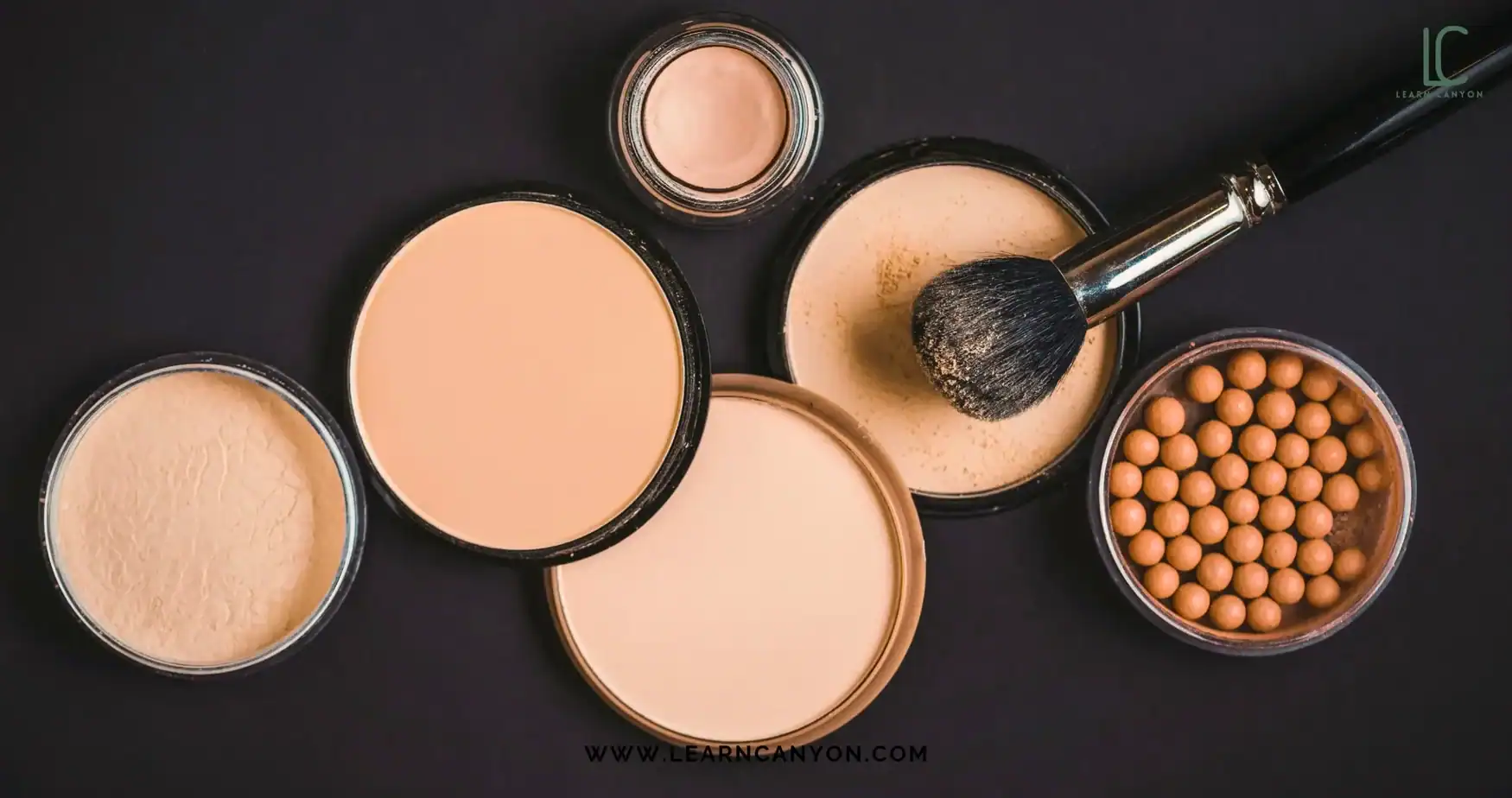
Loose Setting Powder
The loose setting powder is one of the best starting points in powder formulation because it teaches you one of the most important balancing acts you’ll ever encounter in this category: how to absorb oil without looking like you’ve dusted the face in flour.
The purpose of a setting powder is to reduce shine, soften texture, extend makeup wear, and create a finished look. But a poorly designed powder does the opposite. It looks grey, chalky, heavy, or sits visibly on the skin — especially on deeper skin tones where white-based formulas can cause an ashy cast.
How the Ingredient System Works
A functional natural setting powder typically includes four types of ingredients working together:
| Ingredient | Key Function |
|---|---|
| Rice Starch or Tapioca Starch | Primary oil absorber and bulk filler; gives softness and slip |
| Sericite Mica | Improves glide and skin slip; prevents dustiness and drag |
| Kaolin Clay | Additional mattifying effect; heavier feel if overused |
| Silica | Soft-focus effect; light scattering for a blurred skin appearance |
| Magnesium Stearate | Critical adhesion agent; helps the powder grip the skin surface |
| Iron Oxides (trace) | Shade correction to prevent ashiness or flashback |
The Formulator’s Truth About “Translucent”
Here is something many beginner formulators get wrong: a truly translucent powder is never purely white. On medium and deeper skin tones, a white-based powder will look grey in daylight and flash back under camera flash, creating that dreaded white cast in photographs.
A professional translucent powder is subtly adjusted with tiny amounts of yellow iron oxide, red iron oxide, or brown iron oxide — or a combination — to warm the base and neutralise the optical effect of titanium dioxide or high levels of silica. The shift is measured in fractions of a percent, but it makes an enormous difference on skin.
This is also why you should always test your loose powder across a range of skin tones before finalising any shade — not just on the lightest skin tone in your test panel.
The most common beginner mistake in loose powder is adding too much starch or clay. This creates what I call the ‘flour face’ problem: the powder sits visibly on the skin and emphasises rather than blurs texture. Keep your absorbent ratio restrained, and always balance it with slip agents like sericite mica. Your target is skin that looks like skin — just quieter.
Mineral Foundation Powder
If loose setting powder is the warm-up, mineral foundation is the advanced class. It requires everything a setting powder needs — smooth texture, good adhesion, comfortable wear — plus buildable, even coverage that actually evens out the complexion without looking mask-like.
This is one of the most technically demanding powder products you will ever formulate, and it is also one of the most commercially meaningful. Done well, a mineral foundation is a genuinely transformative product. Done poorly, it looks grey, patchy, cakey, or oxidises to the wrong shade within an hour.
The Coverage System
Coverage in a mineral foundation comes primarily from titanium dioxide (TiO2) and zinc oxide (ZnO). These are your opacifiers. TiO2 gives higher opacity and a brightening effect. ZnO is gentler, slightly less opaque, and contributes broad-spectrum UV protection as a bonus.
The challenge is that both of these ingredients are white. They bounce light — which is exactly what you want for coverage — but they also have to be carefully balanced against your iron oxide pigments, or the formula will look pale, ashy, or chalky on skin.
A mineral foundation also needs excellent adhesion. Without it, coverage disappears within the hour. Magnesium stearate is your primary adhesion tool here, but the grade and particle size of your mica will also play a significant role.
Shade Development: The Real Work
Shade development for a mineral foundation line is where formulation becomes a genuine craft. You are not simply mixing “light,” “medium,” and “dark” shades. You are building an undertone system.
A well-designed foundation line includes:
- Warm tones: golden or peachy undertones, requiring more yellow and red iron oxide
- Cool tones: pink or rosy undertones, requiring a more careful balance of red and sometimes a touch of ultramarine blue (where approved)
- Neutral tones: balanced across warm and cool, often the most complex to dial in
- Olive tones: warm but with a green quality; may require careful yellow-iron oxide adjustment
- Deep warm and deep neutral: richer concentrations of red, yellow, and brown iron oxide, with very careful TiO2 calibration to avoid ashy lightening
Two foundations can look identical in the jar and look completely different on skin because one pulls warm and the other pulls cool. This is why you cannot skip the wear-testing phase, and why testing on multiple skin tones is non-negotiable.
Oxidation — where a foundation shifts darker or warmer on the skin over time due to interaction with sebum — is a real challenge in mineral foundation. Test your shades after at least four hours of wear, not just at application. Some shade adjustments that look perfect at first swatch will shift significantly by midday.
Pressed Face Powder
Pressed powder looks like the simpler sibling of loose powder, but experienced formulators know it is actually more technically demanding. The formula must do everything a loose powder does — absorb oil, feel silky, look good on skin — but it must also hold together in a compact and survive a drop test.
This introduces a whole new variable: the binder system.
Understanding the Binder System
A binder is what allows dry powders to press and hold their shape. In natural cosmetic formulation, binders are typically oils or esters — lightweight enough not to make the formula feel greasy, but present in sufficient concentration to create cohesion.
The balance you are looking for is nuanced:
- Too little binder: the compact cracks, either immediately or after a few days as oils migrate or the product dries further
- Too much binder: the powder becomes hard, resistant to brush pickup, or develops a ‘glazing’ effect on the surface
- Wrong binder type: can cause oil bleeding, rancidity risk if using unstable oils, or a heavy skin feel
Common natural binder options include jojoba oil, caprylic/capric triglyceride, squalane, coco-caprylate, and hemisqualane. For formulas that need extra cohesion, a very small amount of carnauba wax or beeswax can help.
Testing Pressed Powders Properly
A pressed powder formula must be tested extensively. Day-one results are not enough. You need to evaluate:
- Payoff on a brush and with finger application
- Drop test from approximately 90 cm onto a hard surface (multiple times)
- Surface hardness after 48–72 hours
- Hard pan formation — does the surface glaze after repeated use?
- Oil bleeding — is the binder separating and creating greasy spots?
- Shade consistency through the depth of the pan
Hard pan is one of the most frustrating problems in pressed powder formulation. It happens when the binder migrates to the surface under pressure, creating a glazed layer that a brush cannot penetrate. The fix usually involves reducing binder concentration, changing the binder type, or adjusting the pressing pressure. It rarely shows up on day one, so always rest your pressed compacts for at least 72 hours before evaluating them.
Powder Blush
Powder blush is where pigment behaviour becomes one of your primary formulation challenges. A blush needs to deliver colour — but not too much colour in one swipe. It needs to be buildable and blendable, flattering across skin tones, and consistent in payoff from the first use to the last.
The core challenge is dispersion. If your pigments are not evenly distributed throughout the base, you will get streaky or patchy colour, hot spots of intensity, or uneven application. This is especially problematic with red and dark brown iron oxides, which are highly concentrated pigments.
Natural Pigment Options — and Their Limitations
Iron oxides are the backbone of natural blush formulation. Red iron oxide gives the primary flush of colour. Yellow iron oxide warms the tone. Brown iron oxide deepens and adds richness. Combined in different ratios, you can achieve everything from soft peachy corals to deep berry plums.
Manganese violet can add a muted mauve or lilac quality where regulations permit. Ultramarines in pink tones (where permitted by regional regulations) can help with cooler rose shades.
You will notice that botanical powders — beetroot, hibiscus, rose — are not on this list as primary pigments, and that is intentional. Here is the honest reality:
- Botanical powders are unstable as colour cosmetic pigments. They fade, they oxidise, they can develop off-odours over time
- They behave unpredictably when combined with other ingredients
- They are not regulated as cosmetic colorants in the same way mineral pigments are, which creates compliance uncertainty
- In professional colour cosmetics, mineral pigments are more reliable, more consistent, and more defensible
You can absolutely include small amounts of botanical powders for ingredient story and added benefit — rose powder adds a beautiful note to the INCI list and can contribute skin-feel benefits. But your colour system should be built on stable mineral pigments.
Pre-disperse your pigments. In a professional setting, pigments for blush are typically milled or dispersed into a carrier before being incorporated into the full batch. For small-batch formulation, a dedicated coffee grinder or a thorough pass through a mortar and pestle will dramatically improve your colour uniformity. Never add raw iron oxides directly to a powder blend and expect even dispersion — they will clump.
Bronzer
Bronzer is one of the products where formulators most commonly go wrong, because the visual complexity of a good bronzer is deceptive. It looks like “just brown,” but the wrong combination of iron oxides can very quickly produce something that looks muddy, orange, grey, or — worst of all — dirty on the skin.
The Iron Oxide Balancing Act
Most bronzers are built on a combination of yellow, red, and brown iron oxide. The ratios are everything:
- Too much yellow oxide: the bronzer pulls mustard or golden-yellow, which reads as unnatural on most skin tones
- Too much red oxide: brick or terra cotta tones that make the product look orange
- Too much brown oxide: muddy, flat, and greyed-out, especially on fair skin
- Too much black oxide: deepens the shade but rapidly creates a dirty appearance
A warm, believable bronzer shade usually requires a careful lead of yellow oxide, supported by red, with brown and possibly a trace of black to add depth. The ratios will differ based on the target skin tone range.
Matching Bronzer to Skin Tone
A bronzer is not a one-size-fits-all product, and professional formulators know this. Consider developing shade ranges intentionally:
- Light bronzer: soft beige warmth, low pigment load, often with pearl for a fresh finish
- Medium bronzer: golden-brown warmth, medium pigment depth, satin or radiant finish
- Deep bronzer: rich red-brown or amber depth, higher iron oxide concentration, rich finish
Bronzer is also one of the products where a finish decision has to happen early in formulation, not as an afterthought. A matte bronzer needs a different base than a shimmer bronzer, and a body bronzer needs different adhesion properties than a face bronzer. Decide on your finish goal before you build the base, not after.
Highlighter Powder
Highlighter is one of the most creatively exciting categories in powder formulation, and also one that requires genuine technical sophistication to execute well. The goal is to create light reflection and a perception of glow — but in a way that flatters the skin rather than emphasising texture.
A highlighter that is too heavy or too chunky will catch light in all the wrong places. A highlighter that is too fine will disappear. Getting this right is genuinely a particle physics problem.
Understanding Particle Size
In highlighter formulation, particle size is one of your most important design variables:
- Fine pearl mica (small particle): creates a smooth, skin-like glow; more luminous than glittery; works beautifully for a sophisticated or natural highlight
- Medium pearl mica: visible shimmer with dimension; good for eye-catching highlighter products
- Large particle mica: obvious sparkle; visually arresting but can feel gritty and may not be appropriate for the eye area
The most sophisticated highlighters typically combine particle sizes — a fine pearlescent base for overall glow, layered with medium or larger particles for dimension and depth. This prevents the flat, single-note shimmer effect that reads as inexpensive.
Effect Pigments and Natural Standards
Natural standards vary in how they handle synthetic fluorphlogopite (lab-grown mica), boron nitride, and some interference pigments. Check your certification requirements carefully if you are formulating for a certified natural or organic standard. Some gorgeous duo-chrome effects are achievable with tin oxide-coated or iron oxide-coated micas that fall within many natural standards, depending on your certification body.
Test your highlighter in multiple lighting conditions: natural daylight, indoor warm lighting, and under a camera flash. A highlighter that looks stunning in daylight can read as grey and flat under indoor artificial light. Build your finish to perform across environments, not just on a bright photo set.
Pressed Eyeshadow
Pressed eyeshadow is one of the most technically demanding products in colour cosmetics, and it is also one of the best formulation teachers. It requires excellent colour payoff, smooth blending, low fallout, strong adhesion to the lid, comfortable wear, and a pressed compact that holds together.
And it has to achieve all of this with a restricted list of pigments, because not every colorant approved for face use is also approved for the eye area.
Eye Safety and Colorant Regulations
This is critical knowledge for any professional formulator. Colorant approval for the eye area is a separate regulatory category in most markets — and the approved list is shorter than for face cosmetics.
In Canada, the Cosmetic Ingredient Hotlist governs which ingredients are restricted or prohibited; in the EU, Annex IV of the Cosmetic Products Regulation specifies permitted colorants and their approved use areas; in the USA, the FDA’s list of permitted color additives applies. Each market has its own approved and restricted lists, and they do not always align.
As a formulator, you must verify colorant compliance for the eye area in every market where your product will be sold. This is not optional. It is a regulatory and safety requirement.
Matte vs. Shimmer Eyeshadow: Different Challenges
Shimmer eyeshadows are often more forgiving to formulate because the mica itself provides payoff, texture, and slip. Matte eyeshadows are genuinely harder — the pigment and base powders have to do all the work, and without shimmer to help blend and soften, any patchiness or chalkiness is immediately visible.
For matte shadows, you need:
- Higher pigment concentration relative to shimmer shadows
- Very thorough pigment dispersion to avoid patchiness
- A slip agent to aid blending — sericite mica and boron nitride (where permitted) are useful here
- Careful binder calibration to ensure pickup without hard pan
Fallout is one of the biggest consumer complaints in eyeshadow products — and one of the clearest signs that a formula’s adhesion system needs work. Fallout happens when particles separate from the product and drop onto the cheek during application. Test your eyeshadows by applying them over a white piece of paper and evaluating how much product falls. Then fix accordingly — usually by increasing magnesium stearate or adjusting the binder.
Body Shimmer Powder
Body shimmer is one of the most joyful products to formulate, and also one where there is significant room to differentiate through skin tone-awareness and sensory design. This is a category where premium feel and colour sophistication matter just as much as pigment load.
Body shimmer also tends to be more forgiving than face or eye powder in terms of shade precision — but that does not mean you can be careless. A body shimmer that feels dry, dusty, or overly glittery in texture will not perform well at any price point.
Designing for Skin Feel
The body shimmer market has moved away from heavy, dusty, obviously glittery powders toward formulas that feel more like a veil of light on the skin. The pearls should feel smooth and fine, the base powders should provide enough cushion that the product glides without drag, and the overall sensory experience should feel luxurious rather than sparkly.
For pressed body shimmer, your binder system is especially important because body products tend to be applied with hands or a large brush and need good pickup. Liquid-feeling esters work well here.
Skin-Tone Appropriate Shades
A professional body shimmer line should include options across the skin tone spectrum:
- Champagne and gold: beautiful for fair to light medium skin tones
- Warm gold and bronze: flattering on medium to tan skin tones
- Deep bronze, amber, and cocoa shimmer: designed specifically for deep and dark skin tones where lighter shades can disappear
A champagne gold that looks stunning on light skin can be nearly invisible on a deep skin tone. A deep bronze that glows magnificently on dark skin may look overpowering on fair skin. Design your shade range intentionally.
Body shimmer is an excellent candidate for seasonal limited editions, gifting collections, and bridal ranges — and the relatively lower regulatory burden compared to eye products makes it a good category for newer formulators to build commercial product experience in. That said, do not skip safety assessment. Body shimmer covers large surface areas and may remain on the skin for extended periods.
Powder Cleanser
Powder cleansers sit beautifully at the intersection of powder formulation and skincare science, and they are increasingly popular in the clean beauty space for a practical reason: without water in the formula, you sidestep many of the preservation challenges associated with traditional rinse-off cleansers.
However, “no water in the jar” does not mean the product is automatically safe from microbial risk. Once a consumer adds water at the point of use, the product becomes vulnerable. Usage instructions matter enormously here — always ensure the product is clearly labelled for use in a way that prevents water contamination of the remaining powder.
Formulation Goals
A good powder cleanser should activate into something soft, cushiony, and creamy when mixed with water — not a gritty paste. The cleansing action should feel gentle rather than stripping. This is especially important for a facial product, where over-exfoliation and barrier disruption are real concerns.
Mild powdered surfactants such as sodium cocoyl glutamate, sodium lauroyl oat amino acids, or similar amino acid-derived surfactants work well in this category. They activate with water and foam gently, providing clean-rinsing cleansing without harshness.
Enzyme powders (papain, bromelain) can add a soft exfoliating dimension, but require careful handling. Enzymes are sensitive to heat, moisture, and pH — and their activity needs to be preserved in the powder state. Stability testing is essential.
The texture of the activated powder is everything in this product. Test yours by mixing with different water temperatures and ratios. Does it become creamy or gritty? Does it rinse away cleanly or leave a film? Does it foam gently or not at all? These are the experiences your consumer will have, and they determine whether someone repurchases.
Powder Face Mask
Powder masks are beloved in the natural skincare world for the same reason as powder cleansers: the absence of water allows for a more botanically rich formula without the same preservation pressures as a ready-to-use emulsion.
This category is a strong match for clays — kaolin for gentle oil absorption, French green clay for deeper purifying action, rhassoul for a more mineral-rich and conditioning experience. Combined with soothing powders like colloidal oatmeal, brightening ingredients like licorice root or turmeric extract, or gentle enzymatic exfoliants, you can build masks for virtually every skin concern.
The Over-Formulation Problem
Here is the most common mistake I see in powder mask formulation: the ingredient list is too long.
A mask containing 15 different botanical powders might sound impressive, but it creates several real problems. The colour becomes muddy and inconsistent. The odour becomes complex and potentially off-putting. Skin sensitivity risk increases. And the product becomes harder to stabilise and quality-control.
Always specify an activation medium and ratio in your usage instructions. ‘Mix with water’ is not enough. Is it cold water? Warm water? Rose hydrosol? One teaspoon of powder to two of liquid? The activation experience — consistency, spreadability, rinseability — is part of your product design. Test it and specify it.
Core Formulation Principles for Powder Cosmetics
Regardless of which powder product you are developing, the same foundational principles apply. Understanding these deeply will elevate every formula you create.
Principle 1Texture Is a Function of Particle Physics
When a powder feels silky, creamy, dusty, or velvety, that is not an accident. It is the result of deliberate decisions about particle size, shape, and surface treatment. Fine particles feel smoother but may become airborne. Spherical particles (like certain grades of silica) create a rolling ball effect that contributes exceptional slip. Plate-like particles (like sericite mica) layer and adhere, contributing to coverage and adhesion.
This means that when you are choosing ingredients for a powder formula, you cannot just look at the ingredient name. You must consider grade, particle size, and surface treatment. The same ingredient name from two different suppliers can behave completely differently.
Principle 2Oil Absorption Must Be Calibrated, Not Maximised
More oil absorption is not always better. Highly absorbent formulas can make skin look dry, textured, or aged — especially on mature skin or in dry climates. An over-absorbent formula also tends to feel chalky or dragging.
The goal is appropriate oil absorption for your target consumer. For oily skin: higher clay and starch concentration, balanced with enough slip to avoid chalkiness. For dry or mature skin: lighter on absorbents, heavier on silky powders and adhesion agents. For combination skin: a nuanced balance, often with localised application in mind.
Principle 3Adhesion Is Not Optional
A powder that does not adhere to the skin is a powder that disappears. This is especially important for colour cosmetics — blush, bronzer, eyeshadow, and foundation — where longevity is directly related to adhesion. Magnesium stearate is the primary adhesion agent in most powder cosmetics. Zinc stearate can be used similarly. In pressed products, the binder oils and esters contribute additional adhesion through a film-forming effect on skin.
Principle 4Pigment Dispersion Is a Process, Not an Afterthought
Pigments must be dispersed before they can be formulated. Adding raw iron oxides or ultramarines directly to a powder blend will almost always result in uneven colour — clumps, streaks, hot spots. In professional formulation, pigments are pre-milled or dispersed into a portion of the base powder first, then incorporated into the full batch. This step is non-negotiable for consistent colour payoff.
Principle 5Natural Does Not Automatically Mean Safe
This is important enough to say plainly: natural ingredients require the same rigorous safety thinking as synthetic ones. Some specific considerations for powder cosmetics:
- Microbial quality: botanical powders can carry a high bioburden if not properly tested and specified. Always source from suppliers who provide certificates of analysis including microbial counts
- Heavy metals: clays and some mineral pigments can contain trace heavy metals. Know your supplier’s testing protocols and request results
- Particle size and inhalation: fine powders create airborne particles. Loose face powders should not be so fine and fluffy that they create an inhalation cloud during application
- Eye safety: colorant approval for the eye area is legally distinct from face approval. Check every pigment for every market
- Skin sensitivity: botanical powders, enzymes, and some plant extracts can cause sensitivity reactions in some individuals
How to Approach Your First Powder Cosmetic Formula
When you are starting out with powder formulation, the most valuable thing you can do is resist the temptation to add everything.
Start with a clear product goal. Then build your formula around a simple structure:
| Formula Component | Role and Formulator Notes |
|---|---|
| Base Powder | Rice starch, tapioca, or sericite mica; creates the bulk of the formula |
| Slip Agent | Sericite mica or spherical silica; improves glide and prevents drag |
| Absorbent | Kaolin clay, silica, or absorbent starch; controls oil |
| Adhesion Ingredient | Magnesium stearate; helps the formula stay on skin |
| Pigments | Iron oxides, ultramarines (eye-safe if needed); verified for intended use area |
| Pearls / Micas | For luminosity, glow, or shimmer effects; calibrate particle size carefully |
| Binder System | Oils or esters for pressed products only; test binder concentration carefully |
| Optional Actives | Botanical extracts, enzymes, actives if appropriate, compatible, and stable |
Keep your first batch small — 10 to 25 grams is plenty for a trial. Test it on multiple skin tones. Wear test it. Photograph it. Then adjust.
The most important habit you can build in powder formulation is documentation. A 0.2% shift in iron oxide will change a shade. A 0.5% increase in kaolin clay will change the texture. Write everything down, every time.
Powder Cosmetics Are Physically Honest — and That’s the Gift
Powder cosmetics are one of the most rewarding categories you can study as a natural formulator — not because they are easy, but because they are so physically honest. The formula either works or it does not. You feel it immediately. You see it on the skin.
That immediacy is a gift. Every test batch teaches you something. Every adjustment builds your intuition. And once you genuinely understand how to control texture, adhesion, pigment behaviour, and sensory design in a powder context, you will bring that understanding to every other product category you work in.
A professional powder cosmetic is not just a pretty jar of sparkle. It performs beautifully, feels comfortable, suits the skin tone, stays stable, and is formulated with safety and purpose at the centre.
That is what professional formulation looks like. And that is what we teach at Learn Canyon — not recipes to copy, but principles to understand, so that you can create with confidence across every product category you encounter.
Learn Canyon | Professional Diploma in Natural Makeup and Advanced Colour Cosmetics Formulation. Learn to formulate powder cosmetics — and every other category — with the depth, precision, and confidence of a professional.