Have you ever opened a cosmetic formulation sheet and felt completely lost?
You see a long list of ingredients, unfamiliar INCI names, percentages, different phases, and technical instructions.
Aqua, Glycerin, Cetearyl Alcohol, Glyceryl Stearate Citrate, Xanthan Gum…
Some ingredients sound familiar, while others leave you wondering what they’re doing in the formulation.
And even when you understand a few ingredient names, you might still struggle to see how everything works together to create the finished product.
If you’ve experienced this, you’re certainly not alone.
One of the biggest challenges beginners face isn’t necessarily learning how to make skincare products. It’s learning how to read a cosmetic formula and understand why each ingredient is included.
Because there’s a significant difference between looking at a list of ingredients and understanding the science behind that list.
A professional formulator doesn’t simply see water, oils, emulsifiers, and preservatives. They begin to recognise how the ingredients contribute to the product’s structure, texture, stability, and intended performance.
And the good news is that this is a skill you can develop.
In this guide, we’ll walk through how to read a cosmetic formulation, understand ingredient names and functions, interpret percentages and phases, and begin looking at formulas with a more professional perspective.
Start by Understanding What a Cosmetic Formula Actually Tells You
Before you begin analysing individual ingredients, it’s worth understanding what you’re looking at.
A cosmetic formula is a technical document that identifies the raw materials and quantities used to manufacture a particular product.
Depending on how thoroughly it has been documented, it may also contain information about ingredient phases, manufacturing temperatures, mixing procedures, pH targets, and other important processing requirements.
Let’s say you’re studying a facial moisturiser.
At first glance, you might see water, glycerin, botanical oils, emulsifiers, thickeners, and preservatives.
But a complete formulation tells a much bigger story.
It helps explain how the product has been designed, which materials create its structure, and what conditions need to be controlled during manufacturing.
A Cosmetic Formula Is Different From a Product Ingredient List
Here’s something beginners sometimes overlook.
The ingredient list printed on the back of a moisturiser isn’t the same as the manufacturer’s complete formulation sheet.
A retail ingredient list identifies the ingredients that need to be declared on the product label under the applicable regulations.
It generally doesn’t tell you the exact percentages, manufacturing method, processing temperatures, or complete technical specifications.
A professional formulation document, on the other hand, typically includes much more detailed information.
So while analysing the INCI list of your favourite skincare product can be a useful learning exercise, it won’t necessarily allow you to recreate that product accurately.
Understanding what information a document provides – and what information is missing – is the first step towards reading cosmetic formulations professionally.
Learn to Recognise INCI Names Before Anything Else
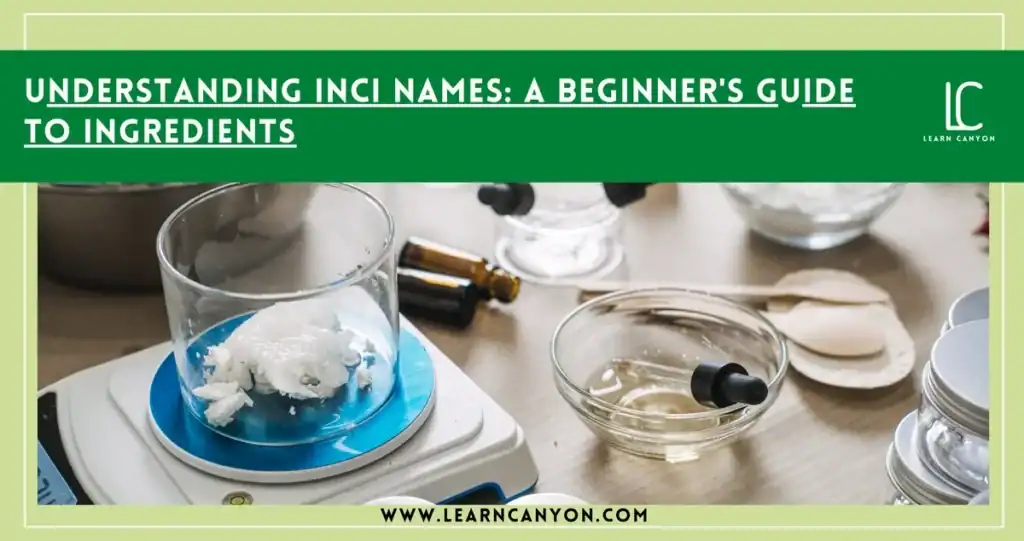
If you’ve ever wondered why cosmetic ingredients sometimes have complicated names, you’re probably looking at their INCI names.
INCI stands for International Nomenclature of Cosmetic Ingredients.
This naming system provides standardised names widely used for identifying cosmetic ingredients.
For example, the ingredient you know as water may appear as Aqua on an INCI list.
Shea butter may be identified as Butyrospermum Parkii Butter, while glycerin is commonly listed as Glycerin.
These names might seem unfamiliar initially, but with practice, you’ll begin recognising them quite easily.
Understanding Common Cosmetic Ingredient Names
Let’s look at a few examples you might encounter while reading a moisturiser formulation.
| INCI Name | Common Identity or Function |
|---|---|
| Aqua | Water |
| Glycerin | Humectant |
| Caprylic/Capric Triglyceride | Lightweight emollient |
| Butyrospermum Parkii Butter | Shea butter |
| Cetearyl Alcohol | Fatty alcohol; consistency and structural support |
| Glyceryl Stearate Citrate | Emulsifying ingredient |
| Xanthan Gum | Thickener and rheology modifier |
| Tocopherol | Vitamin E; commonly used as an antioxidant |
| Sodium Benzoate | Preservative ingredient, subject to appropriate formulation conditions |
Now imagine seeing these ingredients in a formulation sheet.
Instead of viewing them as unfamiliar scientific names, you can begin identifying their possible roles.
And that’s where reading formulas becomes more interesting.
One Ingredient Can Have More Than One Function
An important detail to remember is that cosmetic ingredients don’t always serve just one purpose.
Cetearyl Alcohol, for example, isn’t the same as ethanol. It’s a fatty alcohol commonly used to modify texture and provide structural support in creams and lotions.
Depending on the formulation, it may also contribute to emulsion stability and sensory characteristics.
Similarly, certain ingredients can provide both moisturising and texture-related benefits.
This is why simply memorising one function for every ingredient isn’t enough.
You also need to consider the ingredient’s concentration, the type of formulation, and the other materials present.
Understanding Cosmetic Formula Phases
Once you become familiar with ingredient names, the next thing you’ll probably notice is that professional formulations are often divided into phases.
You might see Phase A, Phase B, and Phase C.
At first, these letters can seem confusing, but they’re actually used to organise the manufacturing process.
Phase A: Understanding the Water Phase
In a typical oil-in-water moisturising cream, Phase A may contain the water-soluble ingredients.
This could include water, glycerin, and certain water-soluble polymers or additives.
The exact ingredients depend on the formulation and processing requirements.
For example, a thickener might need to be dispersed in glycerin before being introduced into water to help prevent clumping.
These details matter because the way an ingredient is incorporated can influence the finished product.
Phase B: Understanding the Oil Phase
In many cream formulations, Phase B contains oil-soluble materials.
You might find botanical oils, esters, butters, fatty alcohols, and components of the emulsifying system.
Depending on the ingredients, this phase may need heating to melt solid materials and prepare them for emulsification.
But don’t assume that every oil phase requires the same temperature.
Different ingredients have different melting points, processing recommendations, and stability limitations.
Phase C: Understanding the Cool-Down Phase
Some formulations include a separate phase for ingredients intended to be added during cooling or at a particular processing stage.
These may include selected extracts, fragrance materials, and other ingredients with specific temperature requirements.
However, preservatives and active ingredients aren’t automatically cool-down ingredients. Their appropriate addition point depends on supplier guidance and formulation compatibility.
And not every formula follows the same A, B, and C structure.
A clear formulation sheet should tell you what each phase represents and when the ingredients are incorporated.
Understanding Cosmetic Ingredient Percentages
Now let’s talk about something that every aspiring formulator needs to become comfortable with: percentages.
If you open a professional formula sheet, you’ll usually see ingredients expressed as percentages by weight.
For example, an ingredient might be listed at 2%, 5%, or 10%.
These numbers tell you how much of that ingredient is used relative to the complete batch.
Learning to Calculate Ingredient Quantities
Imagine you’re preparing a 100 g laboratory batch.
If an ingredient is used at 5%, you need 5 g.
But what happens when you want to manufacture 250 g instead?
You calculate:
Ingredient weight = (Ingredient percentage ÷ 100) × Total batch weight
So for an ingredient used at 5%:
5 ÷ 100 × 250 = 12.5 g
You would therefore need 12.5 g of that ingredient for a 250 g batch.
Once you understand this calculation, interpreting different batch sizes becomes much easier.
It’s also worth remembering that a formulation expressed in percentages isn’t restricted to a 100 g batch.
The percentages remain the same when scaling the quantities mathematically, although larger-scale manufacturing may require changes to processing conditions.
Understanding the Meaning of Q.S. to 100%
Another term you’ll often encounter is q.s. to 100%.
This means adding a sufficient quantity of a specified ingredient to bring the complete formulation to 100%.
Water is commonly used this way.
For example, imagine that the combined percentages of all ingredients other than water total 28%.
The remaining percentage would be:
100% – 28% = 72%
In that calculation, water would represent 72% of the formulation.
These numbers illustrate the mathematics only; they are not a complete cosmetic formula.
The Percentage of a Raw Material Isn’t Always Its Active Concentration
Here’s something many beginners don’t realise.
Some cosmetic raw materials are supplied as solutions or blends rather than as pure substances.
For example, imagine a raw material solution contains 10% of a particular active substance.
If that raw material is incorporated into a formula at 2%, the final concentration of that active substance contributed by the material would be 0.2%.
This distinction becomes especially important when working with diluted ingredients, commercial blends, and certain active materials.
You need to understand exactly what your supplier is providing.
Otherwise, you may confuse the amount of raw material added with the actual concentration of a particular component in the finished product.
Reading a Cosmetic Formula by Ingredient Function
Now that you’re familiar with INCI names, phases, and percentages, let’s connect everything.
When you’re reading a cosmetic formula, don’t look at ingredients individually without considering the overall product.
Instead, begin identifying the functional groups that work together.
Humectants and Emollients: Understanding Moisturising Systems
In a moisturising product, you may encounter ingredients such as glycerin, propanediol, botanical oils, esters, and butters.
These materials don’t all moisturise the skin in exactly the same way.
Humectants help attract and retain water, while emollients contribute softness, lubrication, and desirable sensory properties.
For example, glycerin and caprylic/capric triglyceride might both appear in a facial moisturiser.
Glycerin primarily contributes humectancy.
Caprylic/capric triglyceride is commonly used as an emollient to improve skin feel and spreadability.
Understanding these differences helps you interpret the overall moisturising approach of the formulation.
Emulsifiers and Stabilisers: Understanding Product Structure
Now imagine that the same moisturiser contains water and oil.
These phases need an appropriate system to create and maintain an emulsion.
You might see ingredients such as Glyceryl Stearate Citrate or other emulsifying materials.
You may also encounter fatty alcohols, gums, or polymers that contribute to the formulation’s structure.
But don’t assume that every ingredient described as an emulsifier will perform identically.
Emulsifying systems differ in their properties, compatibility, processing requirements, and suitability for different formulation types.
The complete ingredient combination matters more than one individual emulsifier.
Preservatives and Antioxidants: Understanding Product Protection
When reading cosmetic formulas, beginners sometimes confuse preservatives with antioxidants.
Although both can contribute to maintaining product quality, they perform different functions.
Preservatives are used to help control microbial contamination in susceptible products.
Antioxidants can help limit certain oxidation reactions, such as those that may affect oils.
For example, Tocopherol may be included to help protect oxidation-sensitive components.
But tocopherol doesn’t replace the need for an appropriate antimicrobial preservation system in a water-containing formulation.
Learning to distinguish these functions is especially important if you’re working with natural-origin cosmetic ingredients.
Understanding What the Formula Doesn’t Tell You
Here’s where reading cosmetic formulations becomes more advanced.
Suppose you have a formula with all the ingredient percentages clearly listed.
Everything totals 100%, and you understand the purpose of each material.
Does that mean you have everything you need to manufacture a successful product?
Not necessarily.
A formula’s ingredient table is only one part of the development documentation.
Manufacturing Instructions Can Change the Final Result
The way a cosmetic product is manufactured can significantly influence its properties.
For example, an emulsifying system may require particular heating conditions, mixing equipment, or processing steps.
A polymer may need a specific hydration or dispersion procedure.
And some ingredients may be sensitive to excessive heat or certain manufacturing conditions.
If you’re reading a formula without its complete manufacturing instructions, you may be missing information necessary to reproduce it accurately.
pH, Stability, and Preservation Need Separate Attention
A formulation sheet might contain a target pH, but that doesn’t automatically mean the finished product will fall within that range.
The pH may need to be measured and adjusted using an appropriate method.
Similarly, having a preservative in the ingredient list doesn’t prove that the finished product is adequately preserved.
And a cream that looks stable immediately after manufacturing hasn’t necessarily demonstrated long-term stability.
Appropriate testing and evaluation are needed to establish these characteristics.
How to Analyse a Cosmetic Formula Like a Professional Formulator
Once you’re comfortable reading basic formulation information, you can start developing a more systematic approach.
Imagine someone shares a moisturising cream formulation with you.
Rather than immediately gathering the ingredients, begin by understanding the intended product.
Is it supposed to be a lightweight facial lotion or a rich body cream?
What type of emulsion is being developed?
What texture and sensory properties are expected?
Then look at the ingredient composition.
Identify the water phase, oil phase, emulsifying system, humectants, stabilisers, and preservation strategy.
Consider whether any raw materials have special processing requirements or compatibility limitations.
You should also look for the version number, batch size, manufacturing procedure, supplier information, and any available test results.
Learning to Read Supplier Technical Documents
One of the most valuable habits you can develop is learning how to use raw material documentation.
- A supplier’s Technical Data Sheet (TDS) can provide information about ingredient properties, recommended use, processing conditions, and compatibility.
- A Certificate of Analysis (COA) provides batch-specific information about selected quality parameters.
- A Safety Data Sheet (SDS) contains relevant hazard and handling information.
These documents serve different purposes, and none should be treated as a substitute for evaluating the finished cosmetic product.
As you become more familiar with them, you’ll find it easier to understand why ingredients are used in particular ways.
Don’t Assume a Formula Is Professional Simply Because It Looks Technical
This is something worth remembering, especially with the number of formulations available online.
A formula containing complicated ingredient names, multiple phases, and percentages may look professional.
But appearance alone tells you very little about its technical quality.
You still need to understand the ingredient selection, calculations, processing requirements, and evidence supporting its suitability.
A formula downloaded from the internet should be critically reviewed rather than automatically treated as validated.
The ability to evaluate that information is what makes formulation knowledge so valuable.
Common Mistakes Beginners Make When Reading Cosmetic Formulas
When you’re new to formulation, it’s easy to make assumptions based on incomplete information.
One common mistake is believing that ingredients with similar functions can always be substituted at the same percentage.
Another is assuming that the most concentrated ingredient is necessarily responsible for the product’s main benefit.
You might also encounter a commercial raw material sold under a trade name and mistake it for a single pure ingredient, even though it contains several components.
And perhaps the biggest misconception is believing that a formula totalling 100% must be technically correct.
Percentages are essential, but they are only one part of cosmetic product development.
The more you learn about ingredient science, compatibility, manufacturing, and testing, the easier it becomes to recognise these limitations.
A Simple Exercise to Improve Your Cosmetic Formulation Knowledge
The next time you find a cosmetic formulation, resist the temptation to start making it immediately.
Instead, spend a little time studying it.
Take a simple moisturiser formula and try identifying the ingredients according to their functions.
Look up unfamiliar INCI names using reliable ingredient references, such as the COSMILE Europe cosmetic ingredient database.
Read the available technical information for each raw material.
Then look at the percentages and try understanding why the formula might use those particular ingredient categories.
Consider how the manufacturing process contributes to the finished structure.
Finally, identify any important information that’s missing, such as stability data, processing specifications, or preservation testing.
You may not be able to answer every question initially, and that’s perfectly normal.
The purpose of the exercise is to develop your ability to interpret the formula rather than simply copy it.
Over time, you’ll begin recognising formulation patterns and making connections between ingredient selection, product structure, and performance.
Building Your Cosmetic Formulation Knowledge With Learn Canyon
If you’re learning cosmetic formulation, you’ve probably noticed that understanding individual ingredients is only the beginning.
You also need to understand how those ingredients work together.
You need to recognise formulation systems, interpret percentages, follow appropriate manufacturing procedures, and evaluate the finished product.
This is where structured education can make the learning process more meaningful.
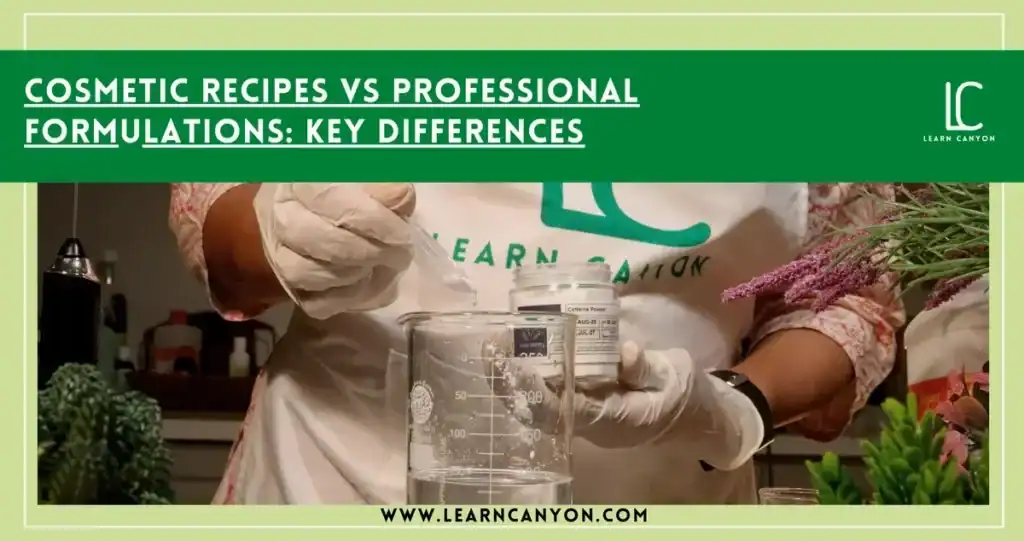
At Learn Canyon, we believe cosmetic formulation education should go beyond giving learners recipes to reproduce.
Our professional formulation courses focus on helping aspiring formulators understand ingredient functions, cosmetic chemistry, formulation calculations, practical manufacturing techniques, and the technical considerations involved in cosmetic product development.
Whether you’re starting from scratch, improving your existing formulation knowledge, or preparing to develop your own skincare or haircare brand, learning how to interpret a formula is an important skill.
Because once you understand what the ingredients are doing, you can begin making more informed decisions about the products you create.
Common Questions About Reading Cosmetic Formulas
Is a cosmetic formula the same as a product ingredient list?
No. A retail ingredient list identifies the ingredients that need to be declared on the product label under the applicable regulations. It generally doesn’t tell you the exact percentages, manufacturing method, processing temperatures, or complete technical specifications. A professional formulation document typically includes much more detailed information.
How do I calculate ingredient quantities from a cosmetic formula?
Use this calculation: Ingredient weight = (Ingredient percentage ÷ 100) × Total batch weight. For an ingredient used at 5% in a 250 g batch, 5 ÷ 100 × 250 = 12.5 g.
What does q.s. to 100% mean in a cosmetic formula?
It means adding a sufficient quantity of a specified ingredient to bring the complete formulation to 100%. Water is commonly used this way. If all other ingredients total 28%, water would represent 72% of the formulation.
Does a formula totalling 100% mean it is technically correct?
No. A mathematically complete formula is not necessarily a scientifically sound formulation. Percentages are essential, but they are only one part of cosmetic product development. Ingredient science, compatibility, manufacturing, and testing also matter.
Final Thoughts: Learn to Understand the Formula, Not Just Follow It
The next time you open a cosmetic formulation sheet, don’t feel intimidated by unfamiliar ingredient names or technical terminology.
Remember that every ingredient has been selected for a reason, even if that reason isn’t immediately obvious.
Start by identifying the product type.
Understand the ingredient functions.
Learn how to interpret the percentages, phases, and processing instructions.
And most importantly, recognise that a good formulation is about more than simply combining ingredients.
It requires technical understanding, careful manufacturing, and appropriate evaluation.
You don’t need to memorise hundreds of INCI names overnight.
Start with the ingredients you encounter most often, build your understanding gradually, and keep connecting what you learn to the science behind the product.
Because the goal isn’t to look at a formulation and recognise every ingredient name.
It’s to understand why those ingredients are there and how they contribute to the finished product.
Ready to Understand Cosmetic Formulation on a Deeper Level?
If you’re ready to move beyond simply following recipes and start developing a stronger foundation in cosmetic ingredient science and formulation techniques, explore the professional courses available at Learn Canyon.
Explore Cosmetic Formulation Courses at Learn Canyon
Your journey towards becoming a knowledgeable cosmetic formulator begins with understanding what’s inside the formula – and why it matters.
Keep learning: Related reading: How to Develop a Beauty Product That Customers Actually Want to Buy · Must-Know Skills for Beginner Cosmetic Formulators. Want to learn this properly? Explore our Free 4-Day Beginner Formulator Experience.